


Dolci & Festività Siciliane
La Colomba Pasquale: history and legend of the typical Easter dessert
Apr
Easter is now upon us. For the Christian religion, it is the most important day of the year, the day on which we remember the resurrection of Christ, which took place on the third day after his death, and which in fact freed man from original sin. Traditionally, it comes on the first Sunday of the full moon after the spring equinox, and after 40 days of Lent, during which fasting and abstinence are observed. And it is precisely to celebrate the Resurrection of Christ and the end of this long period of sacrifices, that our tables on Easter day are spread with every blessing. There are many typical dishes, both sweet and savory, that every Italian region can offer, but if we have to point out the Easter dessert par excellence, which unites all of Italy at the table, from north to south, in addition to chocolate eggs, it is the dove.
It is a leavened dessert, whose dough is very similar to the typical Christmas panettone, covered with amaretto and almond glaze.
But how is the dove born? And why has it become the typical Easter dessert? There are many legends about its origins, as always a mixture of history and fantasy with incredible charm but reliability that must be verified.
According to an early version, the dove was invented in Pavia in 572, at the end of King Alboino’s long siege against the Byzantine Empire. It seems that the inhabitants of Pavia, in order to avoid being looted, offered the king sweets in the shape of a dove, a typical symbol of peace, to sweeten and intoxicate him.
According to a second legend, the dove was still invented in Pavia, but in 610. Queen Teodolinda had invited a delegation of Irish pilgrims, led by Saint Colombano, to lunch. The queen prepared a respectable lunch and offered her guests the best game meat in her possession. Meat that, however, the guests refused to eat because they were in the period of Lent. The queen did not take it so well and felt deeply offended. To overcome the problem San Colombano transformed the meat into bread in the shape of a dove, so that all the diners could eat it.
A third version dates back to 1176, during the Battle of Legnano which saw the towns of the Lombard League clash against the army of Federico Barbarossa. It seems that a commander of the Lombard League, seeing doves pass by, had bread made from eggs, flour and yeast, which were in the shape of a dove, to instill courage in his soldiers.
But all these versions, although very romantic and fascinating, are most likely without foundation. The truth is less romantic and much more pragmatic than the legends. In fact, the dove was invented in Milan in 1930, from an idea of the advertising man Dino Villani who worked for a well-known Milanese confectionery company. The reason is very simple: they wanted to reuse the machinery, which was used to prepare panettone. not only during the Christmas period. This is how the idea was born to create a dessert for Easter, which was precisely the dove.
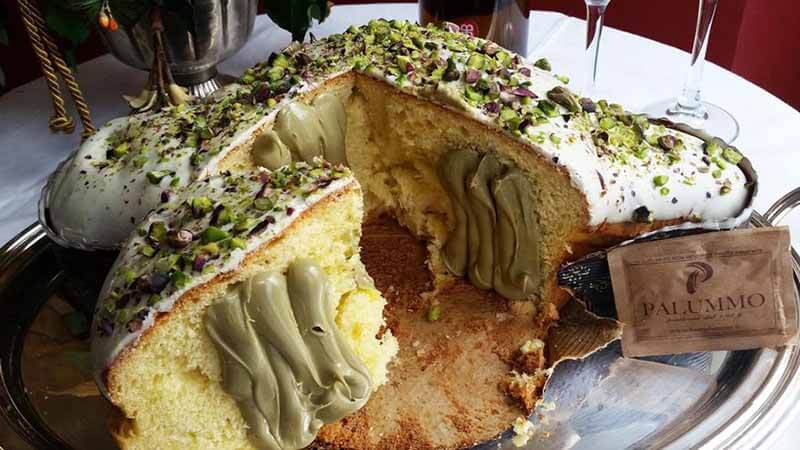
Today, there are different versions of Colomba in our pastries, all always prepared in an artisanal way, with long hours of leavening and with the highest quality local ingredients. In addition to the classic artisan dove with almonds and candies, we have the dove with Nutella and Bronte pistachio grains, the artisan dove with Bronte pistachio cream and the artisan Easter dove with chocolate drops.
If you want to make a good impression with your guests or if you want to try the taste of an artisan dove with an authentic flavor, then you are in the right place.

